Blog
7 Art Nouveau Cities in Germany to Know
Published July 3, 2026
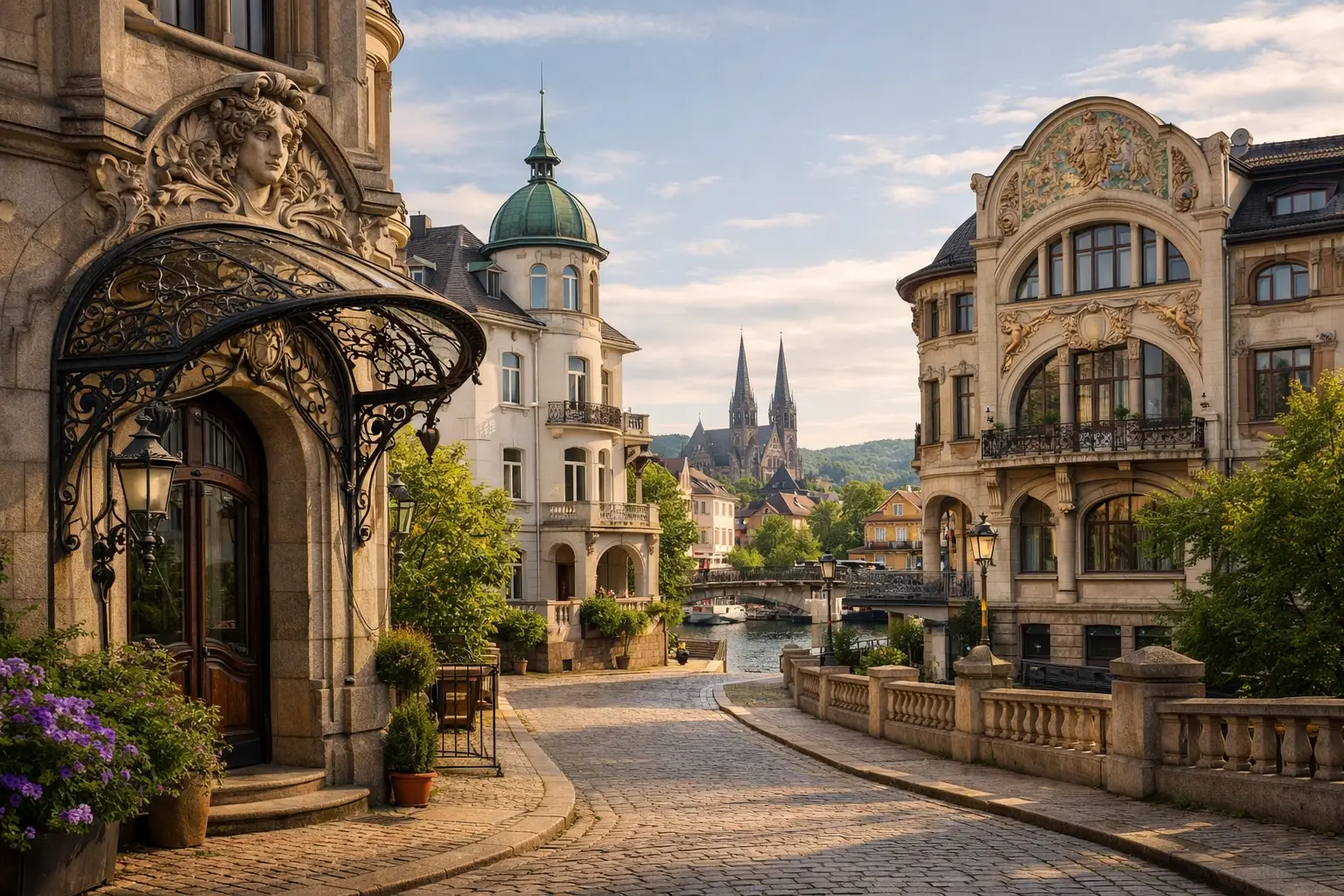
Some German cities announce themselves with medieval towers or Baroque palaces. Others ask you to slow down and look up - at a curved balcony, a floral doorway, a mosaic facade, a tram stop that seems to have drifted out of 1900. That is part of the pleasure of seeking out art nouveau cities in Germany. The style appears here not as a single grand statement, but as a series of local variations shaped by spa culture, industrial wealth, ambitious urban planning, and a surprisingly modern idea of beauty in everyday life.
For American travelers, Art Nouveau in Germany can feel both familiar and slightly elusive. You may know the broad European story through Paris, Brussels, or Vienna, but Germany’s version has its own texture. Often called Jugendstil, it ranges from delicate ornament to geometric restraint, and it turns up in places where daily life still unfolds among these buildings rather than around them as museum pieces. That makes the experience richer. You are not just viewing a style. You are walking through neighborhoods where it still sets the mood.
Why art nouveau cities in Germany feel different
Germany never had one single Art Nouveau capital in the way some countries did. Instead, the movement took root in different settings: prosperous spa towns, expanding industrial cities, wealthy merchant districts, and experimental artists’ colonies. The result is a map of places where Jugendstil reflects local character.
In a spa town, the style often feels graceful and leisurely, built for promenades, concerts, and social display. In a commercial city, it can appear more confident, even muscular, with apartment blocks and civic buildings carrying floral motifs into modern urban life. That variety is exactly why this theme works so well for a Germany-focused trip. You are not chasing replicas of the same place. You are comparing moods.
Darmstadt: Germany’s clearest Jugendstil statement
If one city belongs at the center of this story, it is Darmstadt. The Mathildenhöhe artists’ colony gave Germany one of its most coherent expressions of Art Nouveau, and it still feels remarkably fresh. This was not just a neighborhood where decoration happened to become fashionable. It was a serious attempt to merge art, architecture, design, and daily living.
The buildings here have the elegance people expect from Jugendstil, but they also show its more disciplined side. You see clean lines alongside ornament, a sense that beauty should shape whole environments rather than just facades. The Wedding Tower, exhibition buildings, artists’ houses, and landscaped setting create a place that feels part idealistic manifesto, part beautiful hilltop district.
Darmstadt suits travelers who want context, not just pretty details. It is one of the best places in Germany to understand what the movement meant intellectually as well as visually.
Bad Nauheim: spa-town Jugendstil at its most atmospheric
Bad Nauheim offers a different kind of pleasure. Here, Art Nouveau is tied to the world of early 20th-century wellness culture - bathhouses, curative waters, strolling gardens, music pavilions, and the sort of refined public architecture designed to make health feel glamorous.
The city’s Sprudelhof is one of the great Jugendstil ensembles in Europe, and it is especially rewarding because the setting still makes emotional sense. You can imagine visitors arriving with medical hopes, social ambitions, and enough time to notice ceramic details, ironwork, arcades, and courtyards. The architecture does not feel ornamental for ornament’s sake. It is part of a whole ritual of arrival, treatment, and display.
For travelers, Bad Nauheim has a particular advantage. It is compact, visually consistent, and easy to appreciate without needing a marathon architecture itinerary. If you want one place where German Art Nouveau feels immersive and elegant, this is a strong contender.
Karlsruhe: a city where Jugendstil slips into daily life
Karlsruhe is often discussed for its fan-shaped plan and its role as a center of law and governance, but it also rewards anyone interested in turn-of-the-century architecture. Its Art Nouveau presence is less self-contained than Darmstadt’s and less spa-driven than Bad Nauheim’s. Instead, it appears in residential streets, villas, decorative facades, and urban details that blend into the city’s broader architectural rhythm.
That is part of the appeal. Karlsruhe does not present Jugendstil as a precious relic. You encounter it while moving through a lived-in city with broad streets, green spaces, and a relaxed pace. For some travelers, that feels more authentic than a single monumental complex.
The trade-off is that Karlsruhe asks for a sharper eye. Its rewards are real, but they can be more dispersed. This is a city for wandering rather than ticking off a single headline site.
Wiesbaden: grandeur, resort culture, and ornamental confidence
Wiesbaden has the kind of urban poise that makes late 19th- and early 20th-century architecture feel entirely at home. Known for its thermal springs and upscale resort history, the city contains substantial stretches where Jugendstil appears amid Historicist and Belle Epoque architecture. The effect is not narrowly stylistic. It is atmospheric.
In Wiesbaden, Art Nouveau often feels woven into a broader culture of urban elegance. Apartment houses, villas, and decorative public buildings contribute to streetscapes that reward slow observation. This is a city where facade details matter, but so does the overall composition - the way parks, hillsides, and gracious avenues frame the architecture.
For visitors, Wiesbaden works best if you are interested in the social world that produced these buildings. Jugendstil here is part of a larger story about health, wealth, and sophisticated leisure.
Munich: Jugendstil beyond the postcard image
Munich is not usually the first German city Americans associate with Art Nouveau, which is exactly why it deserves attention. Beneath the better-known image of royal architecture, beer halls, and museum-heavy grandeur lies one of the country’s most interesting urban collections of Jugendstil buildings, especially in neighborhoods that developed around 1900.
The city’s version of the style can feel more urban and more varied than in spa towns. You find apartment buildings with floral stucco, curving ironwork, expressive entrances, and occasional flashes of theatricality, but also a movement toward simplification that hints at modernism. In Munich, Jugendstil is part of a bigger conversation about a city entering the 20th century with confidence.
This is a good choice for travelers who do not want a theme trip to come at the expense of range. Munich allows you to fold Art Nouveau into a broader cultural stay. The downside is that the style competes with many other attractions, so it helps to approach it deliberately rather than assume it will announce itself.
Leipzig: commercial confidence with decorative flair
Leipzig’s wealth around the turn of the century left behind an urban fabric that can be strikingly rich in detail. While the city is often celebrated for music, trade history, and the energy of its historic passages, it also offers a compelling Art Nouveau layer, particularly in residential districts and late 19th-century urban expansions.
What makes Leipzig interesting is the way Jugendstil sits within a city shaped by commerce and ambition. The ornament can be exuberant, but the setting remains unmistakably metropolitan. This is not the dreamy resort world of a spa town. It is a city of business, culture, and confident bourgeois architecture.
For travelers who like seeing how style expresses economic history, Leipzig is especially satisfying. Its architecture feels tied to civic momentum.
Hagen: the less obvious but deeply meaningful choice
Hagen is rarely the first destination people name, yet it belongs in this conversation because of the Hohenhof and the legacy of patron Karl Ernst Osthaus, who helped position the city within progressive design culture. This is a more specialized stop than the others, but that is also what makes it interesting.
Hagen tells a story about reform, design thinking, and the overlap between Art Nouveau and emerging modern ideas. It may not deliver the broad streetscape experience of Wiesbaden or Karlsruhe, but it offers something more focused: insight into how artistic experimentation moved beyond decoration into ways of living and making.
If your interest in Art Nouveau leans toward design history, Hagen can be one of the most rewarding places on the map.
How to choose the right city for your trip
The best art nouveau cities in Germany depend on what kind of travel experience you want. If you want a clear, almost textbook expression of the movement, choose Darmstadt. If atmosphere matters most, Bad Nauheim and Wiesbaden are hard to resist. If you prefer architecture folded into a larger city break, Munich and Leipzig make sense. If you enjoy urban wandering and subtle discovery, Karlsruhe is a strong fit. If you are drawn to design history and don’t mind a more niche stop, Hagen stands apart.
There is also a regional logic to consider. Several of these places work well when paired with other destinations in western or southern Germany, especially if your trip already includes Frankfurt, the Rhine-Main region, or Bavaria. That makes an Art Nouveau theme easier to build into a broader itinerary rather than treating it as a specialist detour.
A final practical note: this is a style best seen unhurriedly. Museums help, but streets, stairwells, parks, bath complexes, and residential facades often tell the fuller story. Morning light can be kind to ornament, and quieter neighborhoods usually reveal more than main shopping streets.
Germany rewards travelers who notice what is hiding in plain sight. In these cities, a doorframe, a tiled fountain, or a row of balconies can change the whole tone of a day - and make the country’s early modern beauty feel unexpectedly close.