Blog
Germany by Rail Guide for Curious Travelers
Published July 10, 2026
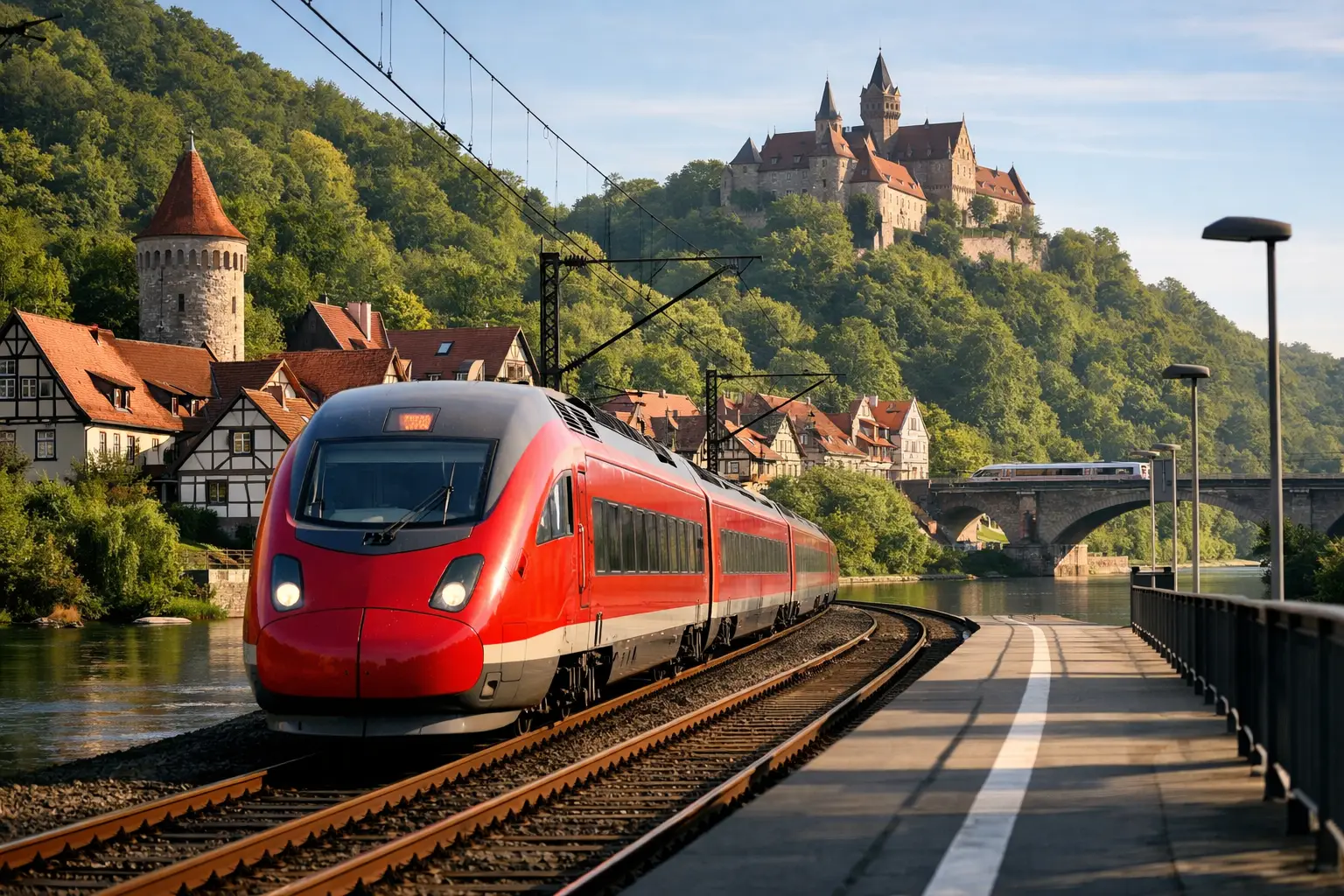
You notice it somewhere between stations: Germany changes quickly by rail. One hour might be all vineyards and river bends, the next a city of brick facades, palace gardens, or postwar modernism. That is the real pleasure of a Germany by rail guide - not simply getting from A to B, but understanding how naturally the country reveals its regions when you travel across it on tracks rather than highways.
For American travelers, Germany is especially well suited to this style of trip. Distances are manageable, stations tend to land you close to old towns or city centers, and the experience feels less like logistical work than part of the journey itself. You are not cut off from the landscape. You watch church spires rise, factories give way to forests, and commuter suburbs dissolve into medieval skylines. Rail travel turns geography into context.
Why a Germany by rail guide makes sense
Germany rewards travelers who like contrast. A few days in one place can be lovely, but moving between regions often explains the country better than staying put. By rail, those transitions feel visible and immediate. You can leave a cosmopolitan city in the morning and arrive in a spa town, wine region, or university city by afternoon with a clear sense that you have entered a different local culture.
That matters because Germany is not a single-note destination. Bavarian pageantry, northern Hanseatic restraint, Rhineland ease, and eastern layers of history do not blend into one uniform national mood. Rail travel makes these distinctions feel legible. Instead of treating the country as a checklist of major stops, you begin to see it as a mosaic of landscapes and identities.
There is also a practical advantage. Driving can be useful in remote rural areas, but in many German cities it adds friction - parking, traffic, environmental zones, and the simple fact that historic centers were not designed for modern car convenience. Trains often place you where you actually want to be: near museums, market squares, river promenades, and neighborhood hotels.
How to plan a rail trip without overplanning
The strongest Germany rail itineraries usually have shape without rigidity. Pick two or three anchors rather than trying to cover the whole country. A first-time visitor might connect Berlin with Dresden and Leipzig, or Munich with Nuremberg and a smaller Franconian stop. Another traveler may prefer a westward line through Cologne, the Rhine corridor, and onward into Baden-Baden or Freiburg. The point is not speed. It is thematic coherence.
A useful way to plan is by region and mood. If you want grandeur and layered history, eastern Germany offers powerful contrasts. If you want rivers, vineyards, and slower afternoons, the southwest or Rhine-adjacent routes feel more atmospheric. If architecture and maritime character matter most, northern cities create a very different rhythm.
Leave breathing room. German rail networks make it tempting to add one more stop, then another, until the trip becomes a sequence of platforms. But one-night stays can flatten a place before it has a chance to register. Two or three nights in each base usually creates a better balance, especially if you want time for a museum, a long lunch, or an unplanned detour.
Understanding train types in a Germany by rail guide
Not every train serves the same kind of trip. Faster intercity services are ideal when you want to cover distance efficiently between major cities. Regional trains are slower, more local, and often more revealing. They are the ones that carry school groups, day trippers, and office commuters, and they pass through the ordinary textures of the country.
If your goal is simply to move quickly from Berlin to Munich, speed matters. If your goal is to understand the transition from one valley town to another, a regional service may be the better experience. That trade-off is worth remembering. Faster is not always richer.
Connections in Germany can be impressively smooth, but they are not immune to delays or platform changes. Give yourself a bit of margin, especially if you are changing trains with luggage or traveling during a busy holiday period. A ten-minute connection may look elegant on paper and feel stressful in real life.
Pass or point-to-point tickets?
This depends on how you travel. If your itinerary is fixed and you know your dates, individual tickets can make sense. If you want flexibility to shift plans, linger somewhere longer, or take spontaneous day trips, a rail pass may feel more comfortable.
There is no universal winner. Travelers who move every day often appreciate the freedom of a pass. Travelers with only two or three major journeys may find point-to-point planning simpler. The important thing is to match the ticket style to your actual habits, not the fantasy version of your trip.
Also remember that flexibility has emotional value. On a rail journey, some of the best decisions happen late - when a city feels too rushed, when weather changes your plans, or when you hear about a nearby town worth seeing. Paying slightly more for that freedom can be worthwhile if you prefer travel that stays open-ended.
What train travel in Germany actually feels like
The station experience varies. Some are polished urban gateways with shops, bakeries, and brisk commuter energy. Others are modest and functional. Either way, German rail travel tends to be straightforward once you learn to read departure boards and platform information calmly.
Bring light luggage if you can. This sounds obvious, but it changes the whole tone of a rail trip. Historic stations may involve stairs, older streets may be cobbled, and the easiest traveler is often the one carrying less than they expected to need. A compact suitcase and a day bag usually outperform a large trunk-style case.
Food is another small pleasure. You can pick up sandwiches, fruit, or pastries before boarding and turn a mid-morning transfer into a civilized pause rather than a rushed errand. On longer rides, the landscape does part of the entertaining. You look up from coffee and notice wind turbines turning over fields, a castle ruin on a ridge, or allotment gardens behind the edge of a city.
Scenic routes and the value of the ordinary
Travelers often ask for the single most scenic train route in Germany, but that question misses something. Yes, certain stretches are famously beautiful, especially along river valleys or near upland regions. Yet Germany by rail is often at its best in the less theatrical moments: red-roofed villages, church towers rising from mist, freight yards beside elegant old stations, the slow arrival into a city you had not fully imagined.
This is one reason rail works so well for a culturally curious trip. It gives you the connective tissue between destinations. You do not just arrive in Saxony, Swabia, or the Rhineland. You see the approach. Landscape, industry, housing, and infrastructure all tell part of the story.
Smart expectations for US travelers
American visitors sometimes expect trains to remove all friction. They do remove some, but not all. Platforms can change. Stations can feel crowded. A route that looks simple may still involve a transfer. If you treat rail as flawless theater, small disruptions become frustrating. If you treat it as a living public system, occasional unpredictability feels manageable.
It also helps to think in terms of station-to-station travel, not door-to-door fantasy. A train may bring you beautifully into the center, but you still need to reach your hotel or apartment, navigate a tram, or walk a few blocks. That final segment is usually easy, but it is part of the trip.
On the other hand, the ease can be remarkable. You may arrive in a city and be standing in its old quarter, museum district, or market area sooner than you would after collecting a rental car and leaving an airport. Germany often feels made for this kind of arrival.
Building a trip around rail, not around checklists
The most satisfying rail journeys in Germany usually resist the urge to do too much. Choose cities and regions that speak to one another. Let architecture, food, landscape, and history create continuity. A rail trip can be urban and elegant, or slow and regionally focused, but it works best when it has a point of view.
That might mean tracing former royal centers, following river country, or pairing a major city with smaller places that sharpen its context. Travel Germany has long made the case that the country becomes more interesting when you look beyond the obvious, and rail is one of the best ways to do exactly that. It encourages curiosity because it keeps you close to the grain of the place.
If you are planning your first train journey through Germany, leave space for the moments between destinations. The station café, the glimpse of a town you had never considered, the stretch of countryside that changes your sense of a region - those are often what remain when the itinerary is over.