Blog
7 Historic Cities in Germany Worth Your Time
Published July 2, 2026
Some places announce their history all at once - with cathedral spires, medieval gates, and market squares that still feel arranged for another century. The most memorable historic cities in Germany do something more interesting. They carry their age lightly, letting Roman walls, Hanseatic warehouses, Baroque streets, and postwar reinvention sit side by side in ways that feel lived in rather than staged.
For American travelers planning a Germany trip, that matters. A historic city is not just a backdrop for photos or a checklist of landmarks. It shapes how you move through a place, what ends up on your plate, how the train station gives way to an old town, and why one region feels markedly different from the next. Germany rewards that kind of close attention because its urban history was never just one story. It is imperial, mercantile, religious, industrial, fractured, rebuilt, and often surprisingly intimate.
What makes historic cities in Germany so compelling
Germany’s historic urban landscape is unusually varied. You can stand in a Roman city on the Moselle, then travel onward to a former Hanseatic port where brick Gothic architecture replaces stone and vineyards give way to sea air. In the south, old episcopal centers and free imperial cities preserve market squares and church towers with almost theatrical clarity. In the east, reconstruction, memory, and restoration often sit in productive tension.
That variety is what makes choosing well more valuable than trying to see everything. Some cities impress through monumental scale, while others work through texture - arcaded streets, uneven cobbles, old guild houses, a river bend lined with facades that look best in late afternoon light. If your interest leans toward architecture, cultural history, or simply places with a strong sense of continuity, the following cities offer distinct versions of Germany’s past without collapsing into the same experience.
Seven historic cities in Germany with real character
Trier
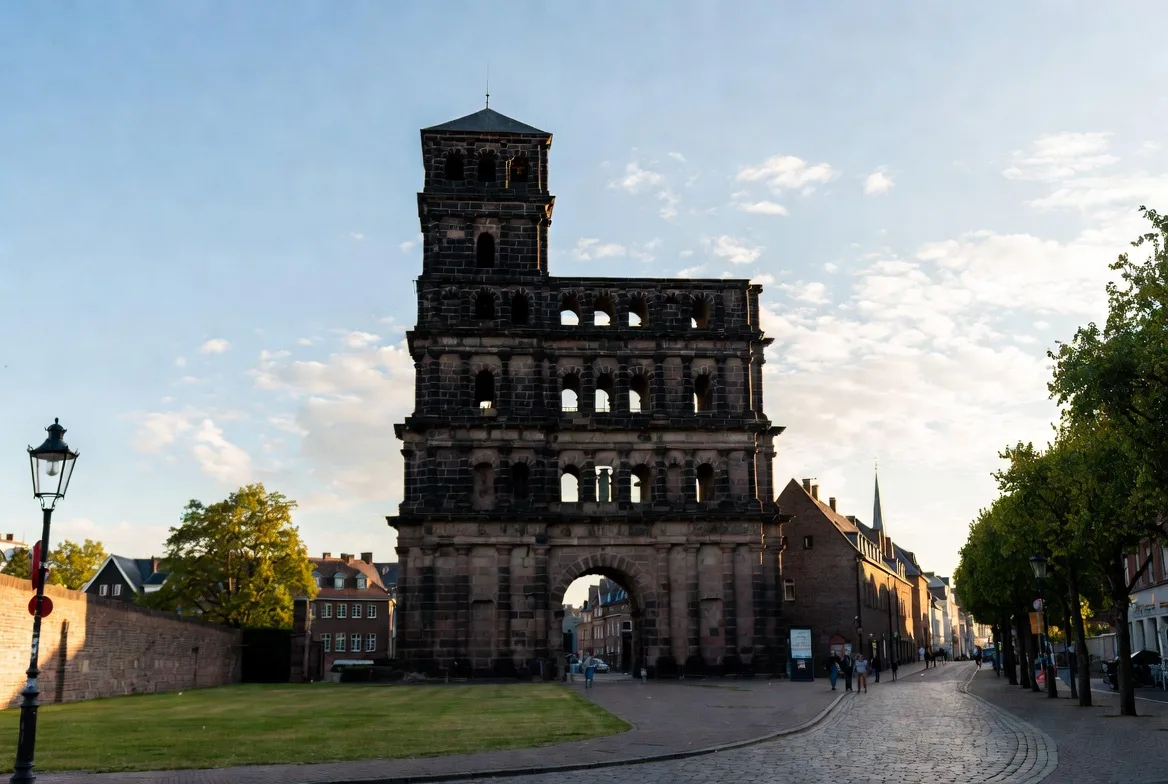
Trier has the advantage of being old in a way few German cities can rival. Founded by the Romans, it still wears that inheritance openly. The Porta Nigra is the headline sight, but the city becomes more compelling once you notice how Roman remains are woven into ordinary urban life - baths, an amphitheater, basilica, and traces of imperial ambition that never feel fully confined to museum space.
Yet Trier is not only Roman. Churches, wine culture, and a softer Moselle atmosphere make it feel less severe than the word ancient might suggest. It suits travelers who like history with layers rather than spectacle alone. You come for antiquity, but often remember the ease of the streets and the sense that the city’s age is still part of its daily rhythm.
Regensburg
Regensburg is one of those places that can recalibrate your idea of what a preserved medieval city looks like. Set on the Danube, it has a remarkably intact old center where merchant houses, church towers, and public squares create an urban fabric that feels coherent rather than selectively restored. There is weight here, but also grace.
Its medieval significance was commercial and political, and that history remains legible in the street plan and skyline. The Stone Bridge and cathedral are obvious anchors, yet Regensburg’s deeper appeal lies in how naturally the city still functions as a place to linger. It never feels reduced to heritage theater. Instead, the old town has the confidence of a city that knows its history is inseparable from its present.
Lübeck
If southern German historic cities often charm through painted facades and church domes, Lübeck offers something sharper and more maritime. As a leading city of the Hanseatic world, it developed a mercantile identity that still defines its appearance. Brick Gothic architecture gives the city a muscular elegance, especially in the great churches and storied gates.
Lübeck is best appreciated as a northern trading capital rather than a generic old town. Its island core, merchant houses, and waterside setting speak to a period when Baltic commerce shaped urban prosperity. For travelers interested in Germany beyond Bavaria and the Rhine, Lübeck makes a strong case for the historic drama of the north.
Bamberg
Bamberg feels unusually complete. Built across seven hills and threaded with river scenery, it has the visual richness people often imagine when they think of an old European city, but with a distinctly Franconian identity. The cathedral, Old Court, and town hall suspended over the river all contribute to a cityscape that is undeniably beautiful.
Still, Bamberg’s appeal is not only scenic. It is also a city of ecclesiastical power, brewing tradition, and layered urban form. That blend gives it substance. Travelers who want a historic setting that is both refined and approachable often respond to Bamberg immediately, especially because it feels ceremonial without becoming stiff.
Quedlinburg
Quedlinburg is smaller than some of the other cities here, but its historical presence is immense. With its dense collection of half-timbered houses and hilltop church complex, it can feel almost improbable in its preservation. The town’s medieval and early modern fabric is not concentrated in one photogenic corner - it extends through the center with a consistency that makes wandering especially rewarding.
There is, however, a trade-off. Quedlinburg is less about big-city energy and more about atmosphere, architectural detail, and historical texture. That is precisely why many culturally minded travelers find it memorable. It invites a slower pace and rewards anyone willing to notice carved beams, sloping lanes, and the quiet authority of old Saxony-Anhalt.
Heidelberg
Heidelberg is often introduced through its romantic reputation, and the setting certainly encourages that reading. The ruined castle above the Neckar, the old bridge, and the baroque old town create one of Germany’s most recognizable historic ensembles. But what gives Heidelberg staying power is the combination of beauty and intellectual life.
This is a university city, and that changes the atmosphere. The past does not sit untouched behind velvet ropes. It circulates through lecture halls, cafes, bookstores, and evening streets full of conversation. If some historic cities feel preserved, Heidelberg feels inhabited in a way that softens its fame and keeps it interesting.
Görlitz
Görlitz remains one of Germany’s most striking urban archives. Near the Polish border, it spans Gothic, Renaissance, Baroque, and late 19th-century styles with remarkable continuity. Because it escaped some of the heavy wartime destruction seen elsewhere, the city offers an unusually broad visual record of central European urban history.
What makes Görlitz special is not only preservation but mood. It feels slightly off the standard route, and that distance from more obvious itineraries gives it freshness. For readers of Travel Germany who want a city where history is palpable without feeling overexposed, Görlitz has unusual depth. It is cinematic, certainly, but it is also thoughtful - the kind of place that invites repeat walks for the pleasure of noticing more.
How to choose the right historic city for your trip
The best choice depends on what kind of history you want to feel. If Roman Germany fascinates you, Trier stands apart. If your interest is medieval trade and urban form, Regensburg and Lübeck are especially rewarding. If you prefer smaller-scale immersion and architectural texture, Quedlinburg offers that in concentrated form.
Landscape also changes the experience. Bamberg and Heidelberg pair historical substance with scenery that softens every walk. Görlitz offers a more eastern perspective, shaped by borderland history and a different architectural cadence. None of these cities is interchangeable, which is exactly the point.
It also helps to think about pace. Some historic cities are ideal for a day of focused wandering, while others can easily sustain a longer stay through museums, neighborhoods, and regional food culture. A city like Lübeck might pair naturally with a broader northern itinerary, while Bamberg or Regensburg works beautifully within a southern route. The right answer is less about ranking than about fit.
Why these places stay with travelers
The enduring appeal of Germany’s historic cities is not just that they are old. Plenty of places are old. What sets these apart is the way history remains spatially clear. You can read power, trade, faith, destruction, and renewal in the streets themselves. The architecture is not merely decorative; it explains why the city exists in its current form.
For US travelers, that can be one of Germany’s quiet strengths. The country rarely presents itself with the easy shorthand of a single national style. Instead, it asks for regional reading. Brick or sandstone, bishopric or port, hill town or river city - each place tells a different version of the past. That makes travel here especially satisfying for people who like context as much as atmosphere.
If you choose one of these cities, give it enough time to move beyond its landmark views. Sit in the square after the church visit, walk the side street after the museum, and notice what the buildings frame rather than only what they are. Historic cities in Germany reveal themselves most fully when you stop treating history as an attraction and start seeing it as the shape of the place around you.