Destinations
Rhine Valley Without the Crowds: Bacharach, Oberwesel and the Quiet Left Bank
August 7, 2026
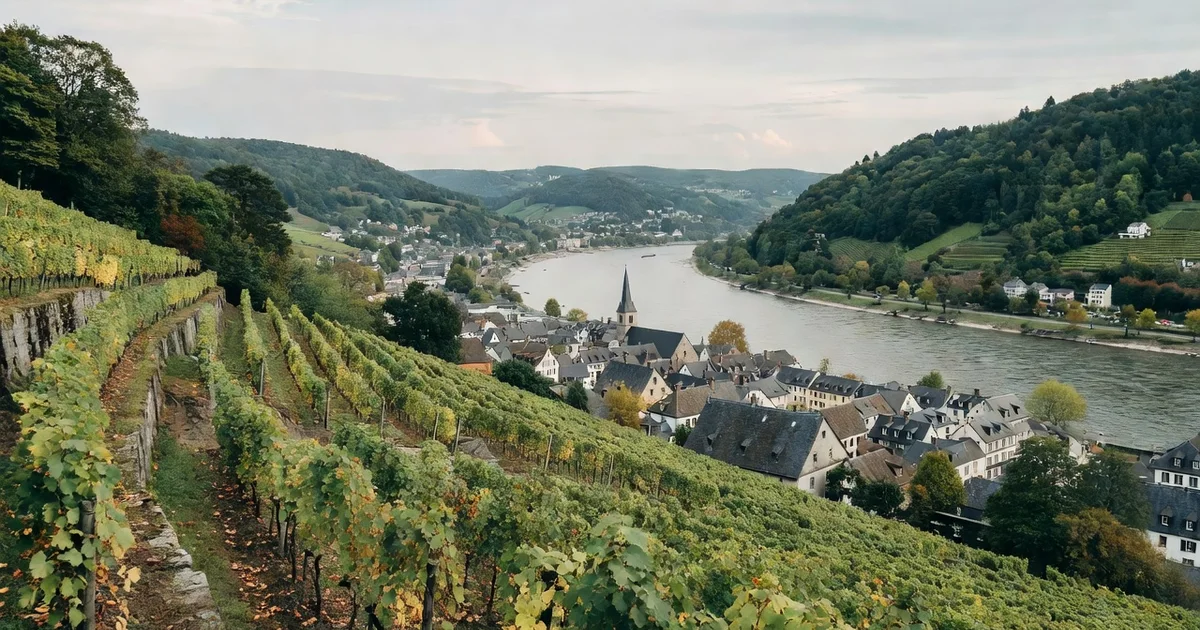
Most people meet the Middle Rhine from a coach window or a boat deck, and most of them meet it on the wrong side. The tour groups concentrate on a handful of right-bank stops — the packed lane of taverns at Rüdesheim, the car park above the Loreley rock — while the left bank of the same UNESCO valley keeps two walled towns that see a fraction of the traffic.
Bacharach and Oberwesel sit about six kilometres apart on the west side of the river, both on the main railway line, both walkable end to end in twenty minutes. This guide covers how to reach them without a car, what is actually worth your time in each, the marked trail that connects them, and the ferry that gets you across to the river's best castle. Prices and opening times below were checked against official sources in August 2026 — the Rhine is a working river and schedules move, so confirm before you travel.
Why the left bank stays quieter
The valley's crowding is not evenly spread. It clusters where the day-trip infrastructure lands: the big cruise piers, the cable cars, the coach parks near the Loreley. Most of that sits on the right bank between Rüdesheim and St. Goarshausen.
The left bank has a different shape. Its towns grew as customs posts and wine ports, tight against the water with the hills pressing in behind, and they never acquired the space for large-scale coach tourism. What they kept instead is their medieval fabric — walls, towers, gates — because there was nowhere for the towns to expand and no reason to knock any of it down.
The practical upshot: you can stand on a section of town wall in Oberwesel in July and have it largely to yourself, ten minutes' train ride from places where you would be queueing. If that trade-off appeals, this is your side of the river. It follows the same logic as our Externsteine visit guide — the interesting version of a famous place is usually one stop away from where the buses park.
Bacharach
Bacharach is the smaller and the prettier of the two, a knot of half-timbered houses inside a wall that still has most of its towers. The town was a wine-trading centre in the Middle Ages, which is why a settlement this size has fortifications this serious.
Above the roofs sits Burg Stahleck, first recorded in 1135. It is not a museum. Since reconstruction work that began in 1925 and finished in 1967, the castle has operated as a youth hostel, and it is popular with school groups — so the building itself is only open to you if you are staying there. What is open to everyone is the climb: the path up from town takes fifteen to twenty minutes and the view over the river bend from outside the walls is the one that ends up on postcards.
Two more things are worth the walk. The Wernerkapelle, a high-gothic chapel above the Peterskirche, is a shell rather than a building — it was wrecked in 1689 when debris from the destruction of Burg Stahleck came down on it, and the ruin was left standing. The Postenturm was part of the town defences, spent years as a water reservoir, and now works as a viewing tower. Both are on the town's marked walking circuit, and the tourist office publishes the route.
Budget half a day. Bacharach rewards slowness rather than a long list of sights, and there is no attraction here you need to book ahead.
Oberwesel, and the wall you can walk
Oberwesel bills itself as the town of towers, and the claim holds up better than most tourist-board slogans. Of an original twenty-one towers, sixteen still stand, linked by a town wall that the municipality describes as the best-preserved fortification on the Middle Rhine. Long stretches of it are walkable.
This is the single best reason to get off the train here. Walking a defensive wall at parapet height changes how you read a river town: you see how the fortifications used the slope, where the gates funnelled traffic, how little space there was between the wall and the water. The circuit is free and open, and it is the sort of thing that would have a ticket office and a timed entry slot almost anywhere else.
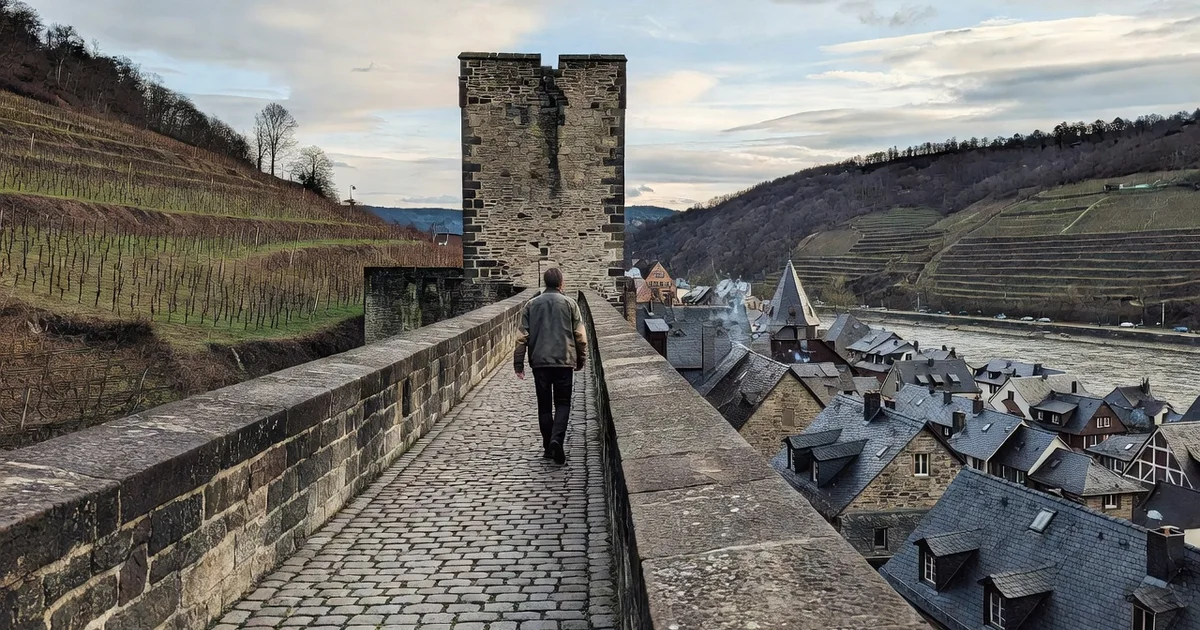
Two churches anchor the town at either end. The Liebfrauenkirche is the red one, gothic and unusually richly furnished for a town this size. The Martinskirche is the white one, set higher up with a tower that reads as defensive rather than decorative. Above everything sits the Schönburg, the castle on the hill, part of which now operates as a hotel.
The walk between the two towns
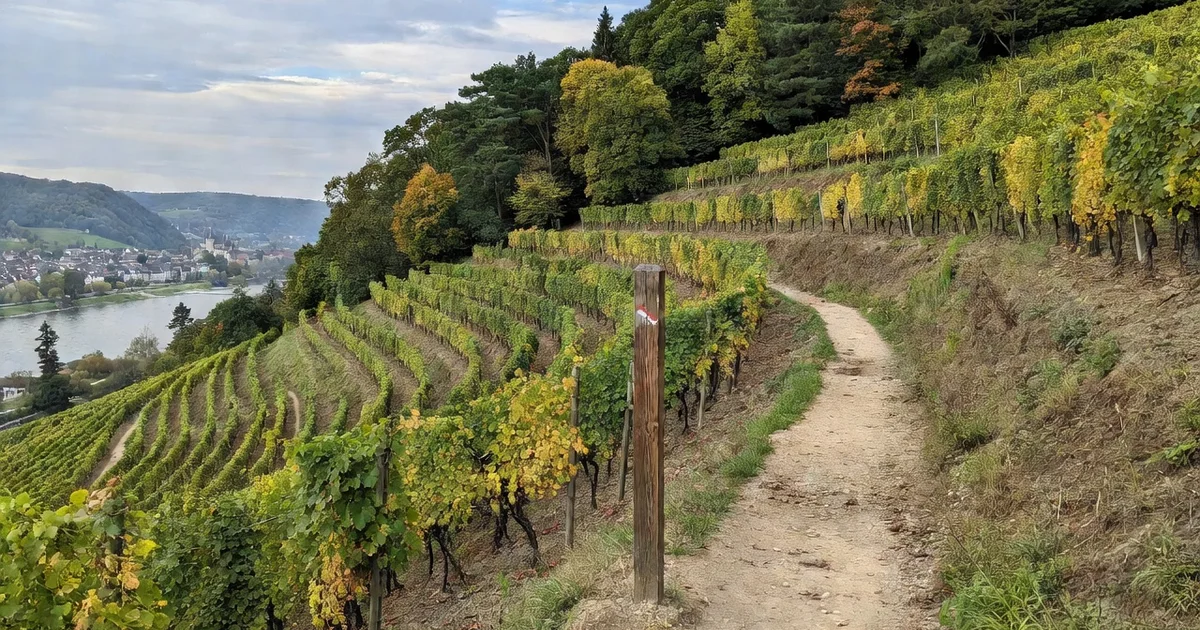
The RheinBurgenWeg is the left bank's long-distance trail — the counterpart to the better-known Rheinsteig on the opposite side, and considerably less busy. Its eleventh stage runs from Oberwesel to Bacharach, and the official stage description gives it as 13.4 km, around 4 hours 30 minutes, medium difficulty.
Note the distance. The two towns are roughly six kilometres apart along the river, so the trail is taking you up and inland rather than along the bank — that is where the gradient and the time go, and also where the views are. It is a hill walk, not a riverside stroll.
The logistics are the good part: walk one way and take the train back, which runs hourly and takes a few minutes. That removes the usual point-to-point hiking problem entirely. If 13.4 km is more than you want, both towns have shorter marked circuits that climb to a viewpoint and come back down, and the tourist offices hand out the maps.
Crossing to Pfalzgrafenstein
The best castle in this stretch of the valley is not on either bank. Pfalzgrafenstein sits on an island in the middle of the Rhine at Kaub — a white and orange toll station shaped like a stone ship, built to stop river traffic and take its money. It never fell, and it was never converted into anything else, which makes it rarer than the hilltop ruins around it.
Getting there is a two-step trip and worth understanding before you set out. First cross the river on the Kaub–Engelsburg ferry, which carries cars and foot passengers, lands on the left bank just north of Oberwesel, and takes about ten minutes. Then, from Kaub, a separate passenger ferry runs out to the island — the castle has no other access.
Admission includes that second ferry. Adults pay €8, concessions €7, children aged 6 to 17 pay €4, and under-fives go free; a family ticket for two adults and up to four children is €16. The season runs from mid-March to the end of October, Thursday to Sunday, 10:00 to 17:00, with reduced November weekend hours and a full closure in December and January.
One warning that matters more than the prices: the island ferry cannot dock when the river is high, roughly above four metres on the Kaub gauge, and the operator also flags weather closures at short notice. Check the official castle page the morning you go rather than building a day around it in advance.
Getting there and getting around
This is an easy region to visit without a car, which is not true of every part of rural Germany.
The left bank railway runs along the water from Köln through Koblenz to Mainz, and the RB26 MittelrheinBahn stops at both Bacharach and Oberwesel roughly hourly, along with St. Goar, Boppard and the rest. Bacharach to Koblenz takes about forty minutes. Both stations are a short walk from the town centres — there is no transfer, no shuttle bus, no last-mile problem.
The Deutschlandticket covers all of it. At €63 per month, it is valid nationwide on regional trains, buses, trams and U-Bahn, which includes every RB and RE service in this valley. It does not cover ICE, IC or EC long-distance trains, so a fast train down from Köln or up from Frankfurt needs its own ticket. For a stay of several days built on regional trains, it usually pays for itself quickly — our Germany train travel tips and scenic train routes guide go further into how to plan around it.
Rhine boats are the scenic alternative. KD runs scheduled services through this stretch and publishes a seasonal timetable, and a one-way leg by boat with a train back is a good way to see the valley from the water without committing a whole day. Two caveats: fares are separate from any rail ticket, and low water causes cancellations and schedule changes — the operator was flagging exactly that during the 2026 season. Treat the boat as a bonus rather than the backbone of your plan.
Practical summary
| Item | Detail (checked August 2026) |
|---|---|
| Deutschlandticket | €63 per month; regional trains, buses, trams, U-Bahn. Not valid on ICE/IC/EC. |
| Train line | RB26 MittelrheinBahn, Köln–Koblenz–Mainz, roughly hourly. Stops at Bacharach and Oberwesel. |
| Bacharach → Koblenz | About 40 minutes by regional train. |
| Oberwesel town wall | 16 of 21 original towers standing; long walkable stretches; free. |
| Burg Stahleck, Bacharach | Youth hostel — interior for overnight guests only. Exterior walk and viewpoint open to all. |
| RheinBurgenWeg stage 11 | Oberwesel–Bacharach, 13.4 km, about 4h30, medium. |
| Kaub–Engelsburg ferry | Car and foot passengers, roughly 10 minutes across. |
| Pfalzgrafenstein admission | Adult €8, concession €7, child 6–17 €4, under 5 free, family (2+4) €16. Includes the island ferry. |
| Pfalzgrafenstein season | Mid-March to end of October, Thu–Sun 10:00–17:00. Reduced November weekends. Closed December and January. |
When to go
May, June and September are the best combination of long daylight, running boats and manageable numbers. July and August still work on this bank — the crowding problem is concentrated across the river — but the walking gets hot, and the climbs out of both towns are steep enough to notice.
Late autumn is the local secret: the vineyards turn, the wine festivals run, and the valley empties out. The trade-off is that the boat timetable thins and Pfalzgrafenstein drops to weekends in November before closing entirely. Winter is for the towns rather than the river — the walls and the churches stay put, but plan around short daylight and a much reduced schedule.
Where this fits in a longer trip
Two nights is the sweet spot: one town as a base, the other as a half-day, the walk or the ferry filling the middle. Bacharach has the better atmosphere for an evening; Oberwesel has slightly more to actually do during the day.
Both connect easily onward. Koblenz is forty minutes north and links to the Mosel; Mainz is south for the wine country. If you are assembling a wider route around towns like these, our castle towns worth the detour and hidden gems in Germany guides cover the rest of the shortlist.
Frequently asked questions
Is the left bank of the Rhine really less crowded?
In this stretch, yes. The large coach and cruise operations concentrate on right-bank stops such as Rüdesheim and the Loreley viewpoint. Bacharach and Oberwesel get day visitors but nothing on that scale, and the Oberwesel town wall in particular is rarely busy.
Can you visit Bacharach and Oberwesel without a car?
Easily. Both sit on the RB26 left bank railway between Köln, Koblenz and Mainz, with roughly hourly service and stations within walking distance of both town centres. A car is a liability here more than an asset — parking is tight and the towns are small enough to cross on foot.
Can you go inside Burg Stahleck?
Only as a hostel guest. Burg Stahleck has operated as a DJH youth hostel since its twentieth-century reconstruction, so there is no general admission to the interior. The walk up and the viewpoint outside the walls are open to everyone and free.
How do you get to Pfalzgrafenstein castle?
By passenger ferry from Kaub on the right bank — there is no other access, and the fare is included in the €8 adult admission. From Oberwesel you first cross on the Kaub–Engelsburg ferry. The island ferry cannot run when the Rhine is high, so check the official site the same morning.
Is the Deutschlandticket worth it for a Rhine trip?
For anything beyond a single day, usually yes. At €63 per month it covers every regional train, bus and tram in the valley, including the RB26. It does not cover ICE, IC or EC services, so long-distance legs to and from the region need separate tickets.
The left bank between Bacharach and Oberwesel, with Kaub and Pfalzgrafenstein across the river